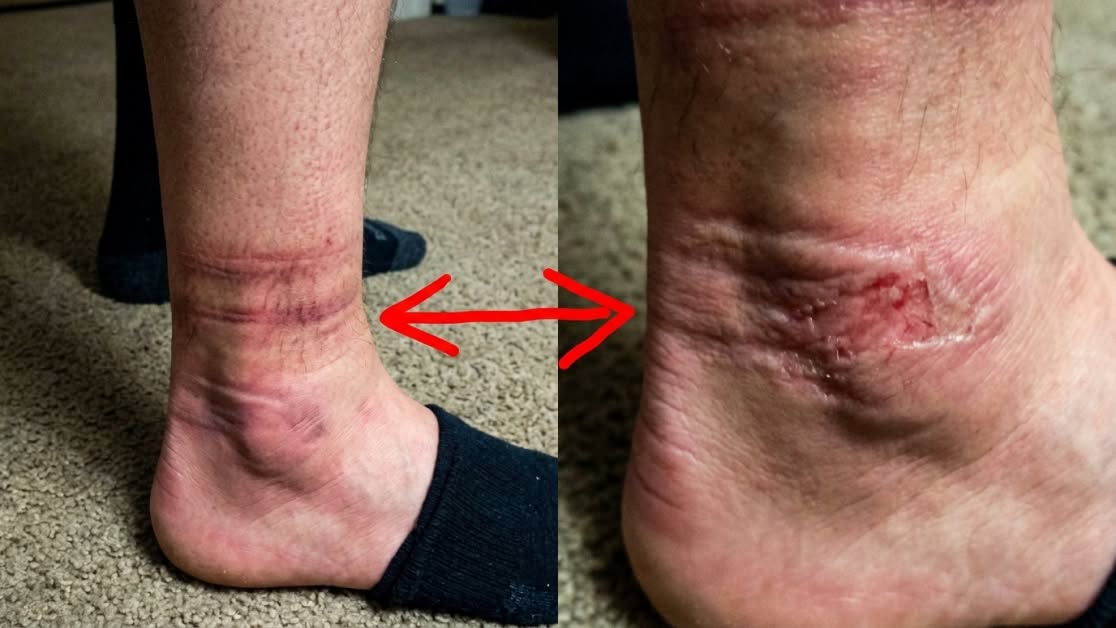
What's actually happening when your ankles swell
Blood arrives in the leg under arterial pressure and has to climb back roughly a metre against gravity through the veins. That return depends on one-way valves and the calf muscle pump squeezing the deep veins each time you take a step. Stand still, sit at a desk, or sit in a plane seat and the pump barely fires. Pressure builds in the veins, and once venous pressure exceeds the pressure of surrounding tissue, water is pushed out of the capillaries into the tissue. That water is your swelling — peripheral edema.
Heat widens veins and makes it worse. So do:
- Long shifts standing on hard floors
- Long-haul flights and long drives
- Pregnancy, especially the third trimester
- Weak or damaged vein valves (venous insufficiency, varicose veins)
- Some medications — certain blood pressure drugs, steroids, hormones
- Salt-heavy days and alcohol
How compression changes the equation
A graduated sock applies its firmest pressure at the ankle and progressively less as it climbs. That does three measurable things:
- Raises tissue pressure outside the vessels, so less fluid can leak out in the first place.
- Narrows the vein slightly, so valve flaps meet better and less blood falls backward.
- Creates a pressure slope — high below, lower above — so the easiest route for blood and fluid is upward, toward the heart.
The full physiology is in how compression socks work. The practical consequence is what people notice: the ankle sock line at the end of the day disappears.
Prevention beats reduction — the timing rule
This is the part most people get wrong. Compression is far better at stopping fluid accumulating than at pushing out fluid that's already there. Put your socks on before you get out of bed, when the leg is at its smallest after a night lying flat. If you wait until lunchtime, you're trying to compress an already-swollen leg — harder to get on, less comfortable, and less effective.
If your ankles are already swollen when you start: elevate your legs above heart level for 20 minutes, then put the socks on while the leg is at its smallest. Repeat daily and most people see the baseline drop over three to five days.
Which strength for swelling?
| Level | Best for |
|---|---|
| 8–15 mmHg | Very mild tiredness; minimal effect on real swelling |
| 15–20 mmHg | Mild puffiness, prevention, travel, first pair |
| 20–30 mmHg | Daily swelling, long shifts, varicose veins, pregnancy — the everyday standard, and the TrueFit rating |
| 30–40 mmHg | Severe venous disease, lymphoedema — prescription only |
Still swollen? Check these four things
- Timing. On before standing, off in the evening.
- Size. Too large means no meaningful pressure; too small means bunching and a bite line. Measure your calf in the morning against the size guide.
- Age of the pair. Compression fades in 4–6 months of daily wear — see washing and lifespan.
- The cause. If swelling is systemic rather than positional, socks manage comfort but won't fix it.
What compression can't fix
Swelling is a symptom, and some causes need treating rather than compressing: heart, kidney or liver conditions, thyroid problems, an allergic reaction, an infection (cellulitis), an injury, a clot, or a medication side effect. Get medical review promptly for:
- Swelling in one leg only, particularly with pain, warmth or redness
- Swelling that appears suddenly
- Swelling with breathlessness or chest pain
- Swelling with fever, or skin that is hot, shiny or broken
- Deep pitting that doesn't improve after a night's sleep
General education, not medical advice. If in doubt, get the leg looked at — a sock is never the right answer to a hot, painful, one-sided swelling.
Habits that stack with compression
- Twenty ankle pumps every hour if you sit or stand still
- Legs above heart level for 15–20 minutes each evening
- Walking breaks — the calf pump is free and highly effective
- Less salt, more water (dehydration makes retention worse, not better)
- Cooling the legs in hot weather
Pick your pack
2 pairs
Try them out — still covered by the 30-day guarantee
$24.50/pair
$49.00 total $104.96
You save $55.96 (53% off)
Choose 2 pairs4 pairs
Enough to rotate through the work week
$22.49/pair
$89.96 total $209.92
You save $119.96 (57% off)
Choose 4 pairs6 pairs
Most chosen — a fresh pair for every day of the week
$19.98/pair
$119.88 total $314.88
You save $195.00 (62% off)
Choose 6 pairsAll prices in USD. A single pair at full price is $52.48 — every bundle includes free worldwide shipping and the 30-day money-back guarantee.
Swelling is a daily problem, so compression only pays off if you wear it daily — which means having a clean pair ready every morning. Read next: compression socks for swollen feet and ankles.




%20--%3e%3csvg%20version='1.1'%20baseProfile='tiny'%20id='Layer_1'%20xmlns='http://www.w3.org/2000/svg'%20xmlns:xlink='http://www.w3.org/1999/xlink'%20x='0px'%20y='0px'%20viewBox='0%200%20512%20210.2'%20xml:space='preserve'%3e%3cpath%20id='XMLID_34_'%20d='M93.6,27.1C87.6,34.2,78,39.8,68.4,39c-1.2-9.6,3.5-19.8,9-26.1c6-7.3,16.5-12.5,25-12.9%20C103.4,10,99.5,19.8,93.6,27.1%20M102.3,40.9c-13.9-0.8-25.8,7.9-32.4,7.9c-6.7,0-16.8-7.5-27.8-7.3c-14.3,0.2-27.6,8.3-34.9,21.2%20c-15,25.8-3.9,64,10.6,85c7.1,10.4,15.6,21.8,26.8,21.4c10.6-0.4,14.8-6.9,27.6-6.9c12.9,0,16.6,6.9,27.8,6.7%20c11.6-0.2,18.9-10.4,26-20.8c8.1-11.8,11.4-23.3,11.6-23.9c-0.2-0.2-22.4-8.7-22.6-34.3c-0.2-21.4,17.5-31.6,18.3-32.2%20C123.3,42.9,107.7,41.3,102.3,40.9%20M182.6,11.9v155.9h24.2v-53.3h33.5c30.6,0,52.1-21,52.1-51.4c0-30.4-21.1-51.2-51.3-51.2H182.6z%20M206.8,32.3h27.9c21,0,33,11.2,33,30.9c0,19.7-12,31-33.1,31h-27.8V32.3z%20M336.6,169c15.2,0,29.3-7.7,35.7-19.9h0.5v18.7h22.4V90.2%20c0-22.5-18-37-45.7-37c-25.7,0-44.7,14.7-45.4,34.9h21.8c1.8-9.6,10.7-15.9,22.9-15.9c14.8,0,23.1,6.9,23.1,19.6v8.6l-30.2,1.8%20c-28.1,1.7-43.3,13.2-43.3,33.2C298.4,155.6,314.1,169,336.6,169z%20M343.1,150.5c-12.9,0-21.1-6.2-21.1-15.7c0-9.8,7.9-15.5,23-16.4%20l26.9-1.7v8.8C371.9,140.1,359.5,150.5,343.1,150.5z%20M425.1,210.2c23.6,0,34.7-9,44.4-36.3L512,54.7h-24.6l-28.5,92.1h-0.5%20l-28.5-92.1h-25.3l41,113.5l-2.2,6.9c-3.7,11.7-9.7,16.2-20.4,16.2c-1.9,0-5.6-0.2-7.1-0.4v18.7C417.3,210,423.3,210.2,425.1,210.2z%20'/%3e%3cg%3e%3c/g%3e%3cg%3e%3c/g%3e%3cg%3e%3c/g%3e%3cg%3e%3c/g%3e%3cg%3e%3c/g%3e%3cg%3e%3c/g%3e%3c/svg%3e)
