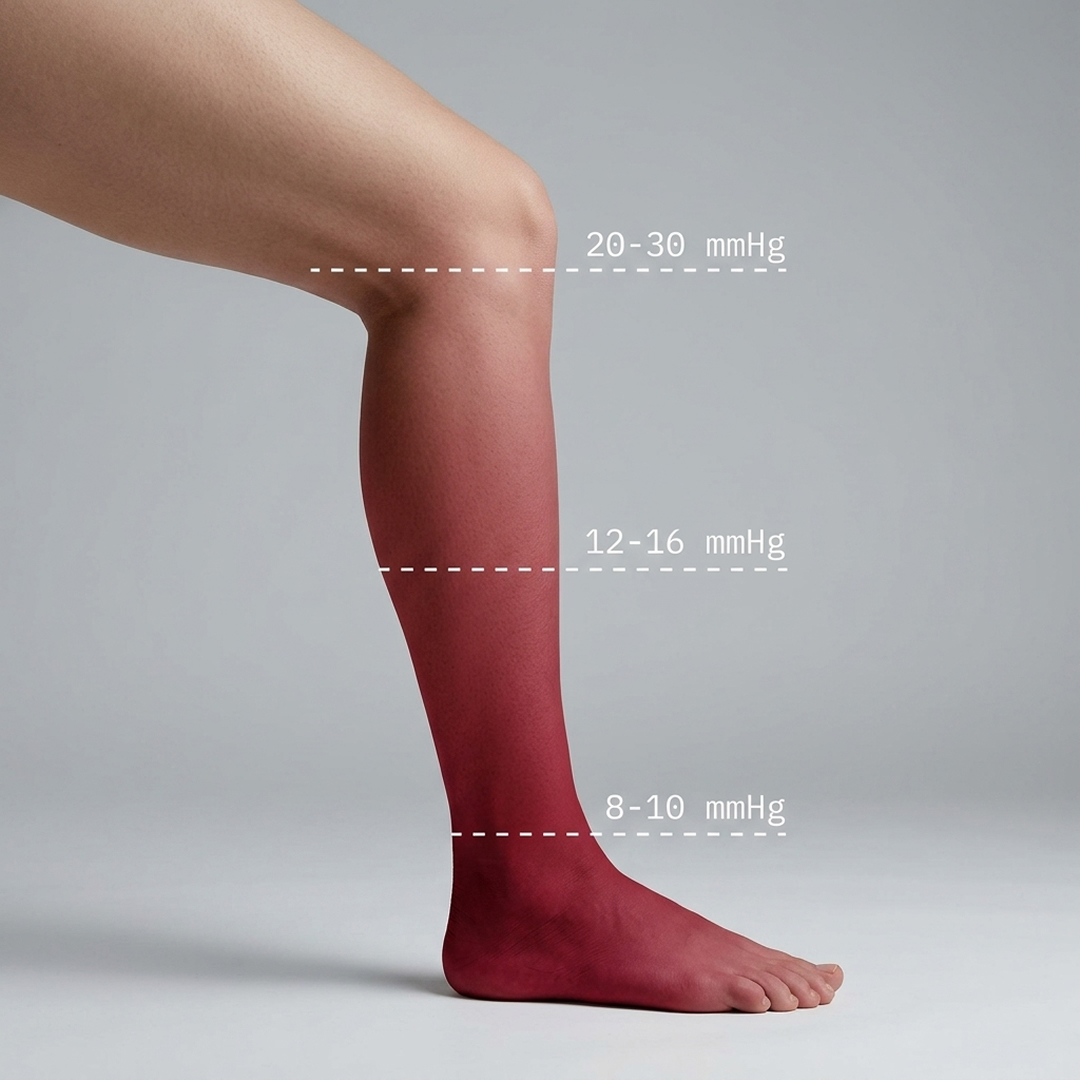
The problem: gravity wins by mid-afternoon
Arteries carry blood down to your feet under pressure from the heart. Getting it back up again is harder — the veins in your legs have to move blood roughly a metre upward against gravity, with far less pressure behind it.
Two things make that possible:
- One-way valves inside the veins that stop blood falling back down between beats.
- The calf muscle pump. Every time your calf contracts, it squeezes the deep veins and pushes a slug of blood upward.
Stand still for hours, sit for hours, or fly, and the calf pump barely fires. Blood pools in the lower leg, pressure builds in the veins, fluid leaks into surrounding tissue — and you get swollen ankles, aching, heaviness and that concrete-legs feeling by evening. If the valves themselves have weakened, this happens faster and more visibly.
What graduated compression actually does
A graduated sock applies its firmest pressure at the ankle and progressively less as it travels up the calf. TrueFit runs 20–30 mmHg at the ankle down to about 12–16 mmHg at the top of the calf.
That gradient does three things:
- Narrows the vein diameter slightly, so the valve flaps meet more effectively and less blood refluxes downward.
- Creates a pressure slope — higher pressure below, lower above — so the path of least resistance for blood is upward, toward the heart.
- Increases flow velocity in the deep veins, which reduces pooling and makes clots less likely to form during long immobility.
Why even pressure does nothing
This is the difference between a real compression sock and a "compression-style" sport sock. A sock that squeezes the same amount from ankle to knee creates no gradient — there is no pressure difference to push blood in a direction. Worse, if it's tightest at the top, it acts like a mild tourniquet and traps blood in the lower leg.
This is also why the top band matters so much. A narrow elastic band that digs in concentrates high pressure at exactly the wrong point. TrueFit uses a wide comfort strap that spreads the hold, so the gradient stays intact from ankle to calf.
What you should expect to feel
- Snug and supportive on the way on — never painful or numbing
- Noticeably less ankle swelling at the end of the day
- Less aching and heaviness after long standing or sitting
- Fewer night cramps and less restlessness for many wearers
If a sock leaves deep grooves, causes tingling, colour change or coldness in the toes, it's the wrong size — see the size guide.
Next
Read compression levels (mmHg) explained to pick the right strength, or how long to wear them.




%20--%3e%3csvg%20version='1.1'%20baseProfile='tiny'%20id='Layer_1'%20xmlns='http://www.w3.org/2000/svg'%20xmlns:xlink='http://www.w3.org/1999/xlink'%20x='0px'%20y='0px'%20viewBox='0%200%20512%20210.2'%20xml:space='preserve'%3e%3cpath%20id='XMLID_34_'%20d='M93.6,27.1C87.6,34.2,78,39.8,68.4,39c-1.2-9.6,3.5-19.8,9-26.1c6-7.3,16.5-12.5,25-12.9%20C103.4,10,99.5,19.8,93.6,27.1%20M102.3,40.9c-13.9-0.8-25.8,7.9-32.4,7.9c-6.7,0-16.8-7.5-27.8-7.3c-14.3,0.2-27.6,8.3-34.9,21.2%20c-15,25.8-3.9,64,10.6,85c7.1,10.4,15.6,21.8,26.8,21.4c10.6-0.4,14.8-6.9,27.6-6.9c12.9,0,16.6,6.9,27.8,6.7%20c11.6-0.2,18.9-10.4,26-20.8c8.1-11.8,11.4-23.3,11.6-23.9c-0.2-0.2-22.4-8.7-22.6-34.3c-0.2-21.4,17.5-31.6,18.3-32.2%20C123.3,42.9,107.7,41.3,102.3,40.9%20M182.6,11.9v155.9h24.2v-53.3h33.5c30.6,0,52.1-21,52.1-51.4c0-30.4-21.1-51.2-51.3-51.2H182.6z%20M206.8,32.3h27.9c21,0,33,11.2,33,30.9c0,19.7-12,31-33.1,31h-27.8V32.3z%20M336.6,169c15.2,0,29.3-7.7,35.7-19.9h0.5v18.7h22.4V90.2%20c0-22.5-18-37-45.7-37c-25.7,0-44.7,14.7-45.4,34.9h21.8c1.8-9.6,10.7-15.9,22.9-15.9c14.8,0,23.1,6.9,23.1,19.6v8.6l-30.2,1.8%20c-28.1,1.7-43.3,13.2-43.3,33.2C298.4,155.6,314.1,169,336.6,169z%20M343.1,150.5c-12.9,0-21.1-6.2-21.1-15.7c0-9.8,7.9-15.5,23-16.4%20l26.9-1.7v8.8C371.9,140.1,359.5,150.5,343.1,150.5z%20M425.1,210.2c23.6,0,34.7-9,44.4-36.3L512,54.7h-24.6l-28.5,92.1h-0.5%20l-28.5-92.1h-25.3l41,113.5l-2.2,6.9c-3.7,11.7-9.7,16.2-20.4,16.2c-1.9,0-5.6-0.2-7.1-0.4v18.7C417.3,210,423.3,210.2,425.1,210.2z%20'/%3e%3cg%3e%3c/g%3e%3cg%3e%3c/g%3e%3cg%3e%3c/g%3e%3cg%3e%3c/g%3e%3cg%3e%3c/g%3e%3cg%3e%3c/g%3e%3c/svg%3e)
