Why standing still is worse than walking
Walking is not the problem. Every step contracts your calf muscle, and that contraction squeezes the deep veins and pushes blood up towards the heart. Physiologists call it the calf muscle pump, and it is the main reason a healthy person can be upright all day without their legs filling up.
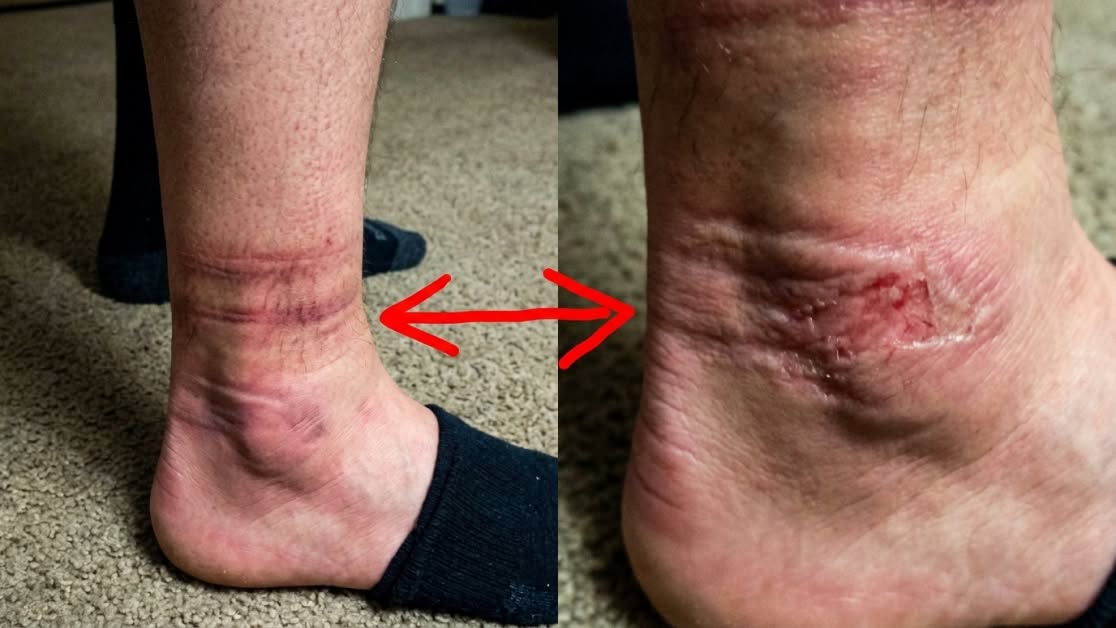
Standing still switches the pump off. Gravity keeps pulling blood down, nothing pushes it back up, and pressure inside the leg veins climbs. Above a certain pressure, fluid crosses out of the capillaries into the surrounding tissue. That is oedema — the puffy ankle, the sock line, the sensation that your legs weigh more at 5 p.m. than they did at 8 a.m.
Graduated compression works on that mechanism directly. It is firmest at the ankle, where venous pressure is highest, and eases as it moves up the calf. The result is a pressure gradient that encourages upward flow, plus a slight narrowing of the vein that helps the internal valves close properly rather than leaking. It does not make you stronger or less tired — it stops the fluid build-up that causes most of what you feel.
The jobs that need this most
- Retail and hospitality — long stints behind a counter or bar with very little walking in between.
- Teaching and lecturing — standing at the front of a room, then sitting to mark, with the pump idle either way.
- Warehouse, factory and site work — hard floors, steel-toe boots, and long shifts.
- Hairdressing, dentistry and lab work — static standing in one spot for hours, often leaning.
- Security, events and stewarding — the extreme case: standing almost entirely still for an entire shift.
- Healthcare — see our dedicated page for nurses and 12-hour shifts.
What compression level to choose
| Level | Feels like | For a full standing shift |
|---|---|---|
| 8–15 mmHg | A slightly snug sock | Not enough to change anything by hour eight |
| 15–20 mmHg | Noticeably firm | Workable for shorter shifts or first-timers |
| 20–30 mmHg | Firm, obvious at the ankle | The right dose for 8–12 hours upright |
| 30–40 mmHg | Hard to put on unaided | Prescription-grade; unnecessary without a diagnosis |
More detail in the mmHg levels guide. If you have peripheral arterial disease, uncontrolled heart failure or numbness in your feet, talk to a clinician before wearing firm compression.
A workday routine that actually works
- Put them on before work. Pull them on in the morning while your legs are at their smallest. Compression prevents swelling far better than it reverses it.
- Check for wrinkles at the ankle. The ankle is where pressure is highest. A fold there creates a pressure point instead of a smooth gradient.
- Move your calves every hour. Twenty heel raises behind the counter restarts the muscle pump. Compression plus movement beats either alone.
- Keep the strap flat. Never roll the top down over itself — a doubled band concentrates pressure at the widest part of the calf.
- Elevate for ten minutes after work. Legs above heart height for ten minutes drains what the day left behind. Take the socks off after, not before.
- Wash after every wear. Cold wash, hang dry. Heat destroys elastane, and a stretched-out sock delivers less pressure than it claims.
Two habits do most of the work: putting them on before the shift, and taking them off at home rather than sleeping in them. See can you sleep in compression socks for why overnight wear is usually pointless for standing workers.
Compression vs the other things people try
| Option | What it addresses | Limitation |
|---|---|---|
| Cushioned insoles | Impact through the sole of the foot | Does nothing for venous pooling above the ankle |
| Better work shoes | Foot posture, arch support, joint load | Same limitation — the problem is in the veins, not the shoe |
| Anti-fatigue mats | Encourages micro-movement, which helps the pump | Only works where the mat is; useless when you move stations |
| Elevating legs after work | Drains fluid that has already accumulated | Reactive — the damage of the day is already done |
| 20–30 mmHg graduated socks | Prevents the pooling in the first place, all shift | Has to be worn correctly and washed after every wear |
These are not mutually exclusive. Compression plus a decent shoe plus ten minutes of elevation is the combination customers report best results from.
What to expect, and when
- Day 1: firm at first, then unremarkable. Most people notice their legs feel lighter at the end of the shift.
- Week 1: the evening heaviness stops being the default. Sock lines get shallower.
- Weeks 2–4: visible ankle puffiness settles for most wearers, provided they are worn consistently on working days.
- Ongoing: compression manages a mechanical problem — it works while you wear it and does not cure underlying venous disease.
How many pairs you need
One pair is not a system. Compression garments must be washed after every wear or the fibres lose recovery and the pressure drifts below spec. For a five-day working week, six pairs means one clean pair per shift plus a spare — and it is the cheapest per pair.
2 pairs
Try them out — still covered by the 30-day guarantee
$24.50/pair
$49.00 total $104.96
You save $55.96 (53% off)
Choose 2 pairs4 pairs
Enough to rotate through the work week
$22.49/pair
$89.96 total $209.92
You save $119.96 (57% off)
Choose 4 pairs6 pairs
Most chosen — a fresh pair for every day of the week
$19.98/pair
$119.88 total $314.88
You save $195.00 (62% off)
Choose 6 pairsAll prices in USD. A single pair at full price is $52.48 — every bundle includes free worldwide shipping and the 30-day money-back guarantee.
Find your size in 30 seconds
Fit is not cosmetic here: the wrong size delivers the wrong pressure. Measure the widest part of your calf in the morning, then answer two questions below.
Find my size in 30 seconds
Enter your shoe size, your calf measurement, or both. Calf width decides it when the two disagree.
Your result will appear here as soon as you enter a number.
Conversions for UK, EU and AU sizing are in the size guide, along with what to do when your shoe size and calf measurement point to different sizes.




%20--%3e%3csvg%20version='1.1'%20baseProfile='tiny'%20id='Layer_1'%20xmlns='http://www.w3.org/2000/svg'%20xmlns:xlink='http://www.w3.org/1999/xlink'%20x='0px'%20y='0px'%20viewBox='0%200%20512%20210.2'%20xml:space='preserve'%3e%3cpath%20id='XMLID_34_'%20d='M93.6,27.1C87.6,34.2,78,39.8,68.4,39c-1.2-9.6,3.5-19.8,9-26.1c6-7.3,16.5-12.5,25-12.9%20C103.4,10,99.5,19.8,93.6,27.1%20M102.3,40.9c-13.9-0.8-25.8,7.9-32.4,7.9c-6.7,0-16.8-7.5-27.8-7.3c-14.3,0.2-27.6,8.3-34.9,21.2%20c-15,25.8-3.9,64,10.6,85c7.1,10.4,15.6,21.8,26.8,21.4c10.6-0.4,14.8-6.9,27.6-6.9c12.9,0,16.6,6.9,27.8,6.7%20c11.6-0.2,18.9-10.4,26-20.8c8.1-11.8,11.4-23.3,11.6-23.9c-0.2-0.2-22.4-8.7-22.6-34.3c-0.2-21.4,17.5-31.6,18.3-32.2%20C123.3,42.9,107.7,41.3,102.3,40.9%20M182.6,11.9v155.9h24.2v-53.3h33.5c30.6,0,52.1-21,52.1-51.4c0-30.4-21.1-51.2-51.3-51.2H182.6z%20M206.8,32.3h27.9c21,0,33,11.2,33,30.9c0,19.7-12,31-33.1,31h-27.8V32.3z%20M336.6,169c15.2,0,29.3-7.7,35.7-19.9h0.5v18.7h22.4V90.2%20c0-22.5-18-37-45.7-37c-25.7,0-44.7,14.7-45.4,34.9h21.8c1.8-9.6,10.7-15.9,22.9-15.9c14.8,0,23.1,6.9,23.1,19.6v8.6l-30.2,1.8%20c-28.1,1.7-43.3,13.2-43.3,33.2C298.4,155.6,314.1,169,336.6,169z%20M343.1,150.5c-12.9,0-21.1-6.2-21.1-15.7c0-9.8,7.9-15.5,23-16.4%20l26.9-1.7v8.8C371.9,140.1,359.5,150.5,343.1,150.5z%20M425.1,210.2c23.6,0,34.7-9,44.4-36.3L512,54.7h-24.6l-28.5,92.1h-0.5%20l-28.5-92.1h-25.3l41,113.5l-2.2,6.9c-3.7,11.7-9.7,16.2-20.4,16.2c-1.9,0-5.6-0.2-7.1-0.4v18.7C417.3,210,423.3,210.2,425.1,210.2z%20'/%3e%3cg%3e%3c/g%3e%3cg%3e%3c/g%3e%3cg%3e%3c/g%3e%3cg%3e%3c/g%3e%3cg%3e%3c/g%3e%3cg%3e%3c/g%3e%3c/svg%3e)