Why nursing is brutal on legs specifically
It is not the walking. Walking is fine — the calf muscle pumps with every step and pushes blood back up the leg against gravity. The damage comes from the static standing: fifteen minutes at a bedside, twenty at a med cart, another stretch at the desk charting. The muscle pump stops, blood pools in the veins below the knee, pressure rises inside those veins, and fluid seeps out into the surrounding tissue. That is the heaviness you feel by mid-shift and the sock line you find when you undress at night.
Repeat that five days a week for years and the one-way valves inside the leg veins take the strain. That is the pathway that ends in visible varicose veins, and it is why nursing, teaching, hospitality and retail all show up in the same occupational health literature. Graduated compression is the cheapest intervention available for it.
Compression substitutes for the pump. Pressure is firmest at the ankle — the point furthest from the heart and lowest in the system — and eases as it travels up the calf. That gradient gives blood a mechanical reason to move upward even when you have not taken a step in twenty minutes. It also narrows the vein slightly, which helps the valves close properly instead of leaking backwards.
What compression level nurses actually need
mmHg means millimetres of mercury — the same unit as a blood pressure reading — and it describes the pressure at the ankle. Higher is not automatically better; it is a dose.
| Level | Typical use | Verdict for a 12-hour shift |
|---|---|---|
| 8–15 mmHg | Light everyday "energising" socks | Too light. You will not notice it by hour eight. |
| 15–20 mmHg | Travel, mild tiredness, first-time wearers | A reasonable entry point if firm pressure worries you. |
| 20–30 mmHg | Occupational standing, swelling, varicose veins | The nursing standard. What TrueFit delivers. |
| 30–40 mmHg | Diagnosed venous disease, post-thrombotic care | Prescription territory. Not for general shift wear. |
Full breakdown in our mmHg levels guide. If you have diagnosed peripheral arterial disease, uncontrolled heart failure or diabetic neuropathy, speak to a clinician before wearing 20–30 mmHg — you know that better than most, but it is worth saying plainly.
The band problem, solved
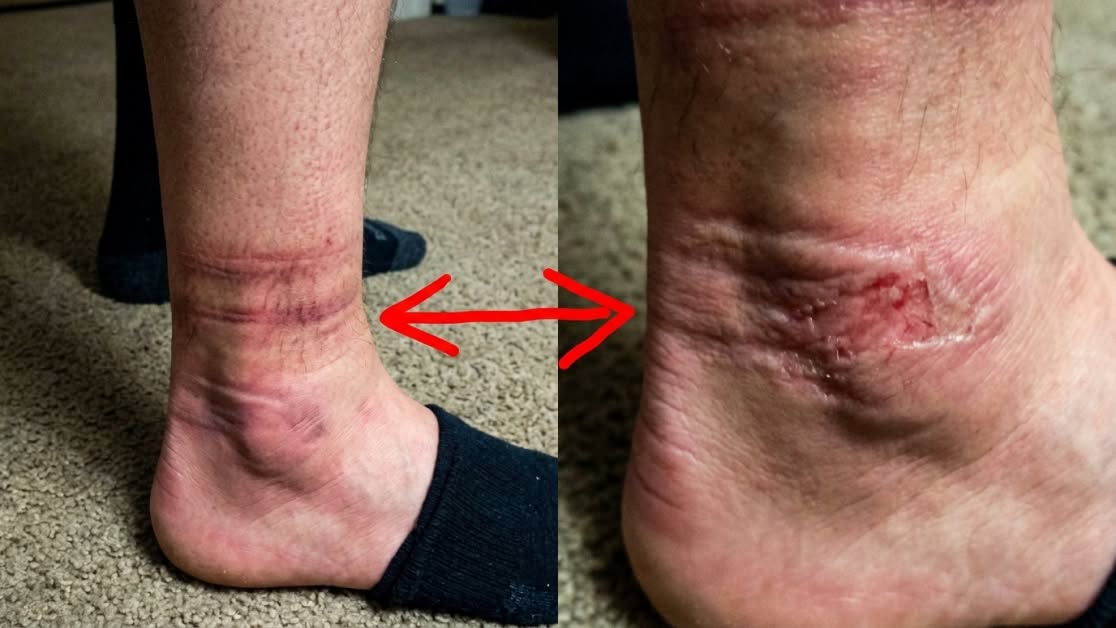
Plenty of nurses already own compression socks and stopped wearing them. The reason is almost always the same: a narrow elastic band at the top that digs a groove into the calf by lunchtime. It happens because a thin band has to generate all of its holding force over about a centimetre of skin. On a muscular or larger calf, that force has nowhere to spread.
TrueFit ends in a wide comfort strap — the same holding job distributed across a much broader surface. It stays up through a full shift without leaving a red ring, and it has a far larger stretch range, which is why it copes with calves that a conventional band simply will not fit. If a sock still leaves a deep mark, that is a sizing problem rather than a design one, and our exchange covers it.
What to look for in a nursing compression sock
- 20–30 mmHg graduated — not a flat-knit "compression-style" sport sock that applies the same pressure everywhere.
- Knee-high — swelling starts at the ankle, so the sock has to cover the whole calf to move fluid anywhere useful. Ankle socks and calf sleeves do not.
- Breathable knit — twelve hours inside a clog is warm and damp. Bamboo-derived fibre wicks and resists odour far better than nylon alone.
- Reinforced heel and toe — the two places nursing socks wear through first, especially in clogs.
- A wide top strap — the single biggest predictor of whether you will still be wearing them in a month.
- Enough pairs to rotate — compression needs washing after every wear, so one pair is not a system.
A wear routine that survives a 12-hour shift
- Put them on before your shift. Pull them on at home in the morning, before any swelling has started — not at handover when your ankles are already full.
- Smooth out every wrinkle. Run your palms up the calf. A fold concentrates pressure in one spot and is the usual cause of a pinch behind the knee.
- Never roll the top down. A doubled-over strap doubles the pressure and creates a tourniquet effect at the widest part of the calf.
- Break at least once mid-shift. Two minutes of heel raises at the med cart restarts the calf pump and works with the compression rather than against it.
- Take them off at home. Compression is for upright hours. Let your legs breathe overnight unless a clinician told you otherwise.
- Wash cold, hang dry, rotate. Compression garments should be washed after every wear. Hang drying keeps the elastane gradient intact for months longer.
If you have never worn compression, start with a shorter shift or a half day for the first two days. Mild aching as your legs adjust is normal in the first week; numbness, tingling, colour change or pain is not — take them off and check the fit. More detail in how long to wear compression socks and side effects and safety.
TrueFit versus the options nurses usually try
| Option | What it does | Where it falls down |
|---|---|---|
| Pharmacy 15–20 mmHg | Mild relief, easy to buy | Pressure fades before the shift does; narrow band digs in |
| Sport calf sleeves | Calf support during activity | No foot coverage, so the ankle — where swelling starts — is untreated |
| Prescription 30–40 mmHg | Clinical-grade venous management | Needs assessment, hard to put on, overkill for healthy legs |
| Thicker ordinary socks | Cushioning underfoot | No gradient at all — cushioning is not compression |
| TrueFit 20–30 mmHg | Graduated ankle-to-calf pressure, wide comfort strap, reinforced heel and toe | Needs washing after every wear, so you need a rotation |
Support socks, compression hose or stockings: what is the difference for nurses?
The names overlap. "Support socks" and "support hose" usually mean light, non-graduated pressure (often 8–15 mmHg). "Compression socks" and "compression stockings" usually mean graduated pressure that is firmest at the ankle. Knee-high compression socks are what most nurses and healthcare workers choose for a shift: they cover the lower leg where blood pools, and they are easier to put on than thigh-high hose.
If you already wear thigh-high or waist-high compression on medical advice, keep following that advice. For everyday tired, heavy legs on long shifts, a graduated knee-high is the practical choice.
Which bundle nurses order
The 6-pair pack is the one that makes sense for a four or five shift rotation — a clean pair every shift with two spare, at the lowest per-pair price we offer. The 4-pair pack suits part-time rotations. The 2-pair pack is the try-it option and is covered by exactly the same 30-day money-back guarantee, worn pairs included.
2 pairs
Try them out — still covered by the 30-day guarantee
$24.50/pair
$49.00 total $104.96
You save $55.96 (53% off)
Choose 2 pairs4 pairs
Enough to rotate through the work week
$22.49/pair
$89.96 total $209.92
You save $119.96 (57% off)
Choose 4 pairs6 pairs
Most chosen — a fresh pair for every day of the week
$19.98/pair
$119.88 total $314.88
You save $195.00 (62% off)
Choose 6 pairsAll prices in USD. A single pair at full price is $52.48 — every bundle includes free worldwide shipping and the 30-day money-back guarantee.
Every bundle ships free worldwide — the US, UK, Canada, Australia, New Zealand, Ireland, across the EU and beyond — priced in USD. See delivery times by region.
Get the size right first time
Compression only works at the pressure it was engineered for, and that depends on fit. Measure the widest point of your calf with a tape measure, first thing in the morning before any swelling. Then use the finder below — it carries your answer straight through to the order form.
Find my size in 30 seconds
Enter your shoe size, your calf measurement, or both. Calf width decides it when the two disagree.
Your result will appear here as soon as you enter a number.
Still unsure between S/M and L/XL? The full size guide has US, UK, EU and AU conversions and what to do if your shoe size and calf size disagree.




%20--%3e%3csvg%20version='1.1'%20baseProfile='tiny'%20id='Layer_1'%20xmlns='http://www.w3.org/2000/svg'%20xmlns:xlink='http://www.w3.org/1999/xlink'%20x='0px'%20y='0px'%20viewBox='0%200%20512%20210.2'%20xml:space='preserve'%3e%3cpath%20id='XMLID_34_'%20d='M93.6,27.1C87.6,34.2,78,39.8,68.4,39c-1.2-9.6,3.5-19.8,9-26.1c6-7.3,16.5-12.5,25-12.9%20C103.4,10,99.5,19.8,93.6,27.1%20M102.3,40.9c-13.9-0.8-25.8,7.9-32.4,7.9c-6.7,0-16.8-7.5-27.8-7.3c-14.3,0.2-27.6,8.3-34.9,21.2%20c-15,25.8-3.9,64,10.6,85c7.1,10.4,15.6,21.8,26.8,21.4c10.6-0.4,14.8-6.9,27.6-6.9c12.9,0,16.6,6.9,27.8,6.7%20c11.6-0.2,18.9-10.4,26-20.8c8.1-11.8,11.4-23.3,11.6-23.9c-0.2-0.2-22.4-8.7-22.6-34.3c-0.2-21.4,17.5-31.6,18.3-32.2%20C123.3,42.9,107.7,41.3,102.3,40.9%20M182.6,11.9v155.9h24.2v-53.3h33.5c30.6,0,52.1-21,52.1-51.4c0-30.4-21.1-51.2-51.3-51.2H182.6z%20M206.8,32.3h27.9c21,0,33,11.2,33,30.9c0,19.7-12,31-33.1,31h-27.8V32.3z%20M336.6,169c15.2,0,29.3-7.7,35.7-19.9h0.5v18.7h22.4V90.2%20c0-22.5-18-37-45.7-37c-25.7,0-44.7,14.7-45.4,34.9h21.8c1.8-9.6,10.7-15.9,22.9-15.9c14.8,0,23.1,6.9,23.1,19.6v8.6l-30.2,1.8%20c-28.1,1.7-43.3,13.2-43.3,33.2C298.4,155.6,314.1,169,336.6,169z%20M343.1,150.5c-12.9,0-21.1-6.2-21.1-15.7c0-9.8,7.9-15.5,23-16.4%20l26.9-1.7v8.8C371.9,140.1,359.5,150.5,343.1,150.5z%20M425.1,210.2c23.6,0,34.7-9,44.4-36.3L512,54.7h-24.6l-28.5,92.1h-0.5%20l-28.5-92.1h-25.3l41,113.5l-2.2,6.9c-3.7,11.7-9.7,16.2-20.4,16.2c-1.9,0-5.6-0.2-7.1-0.4v18.7C417.3,210,423.3,210.2,425.1,210.2z%20'/%3e%3cg%3e%3c/g%3e%3cg%3e%3c/g%3e%3cg%3e%3c/g%3e%3cg%3e%3c/g%3e%3cg%3e%3c/g%3e%3cg%3e%3c/g%3e%3c/svg%3e)