Why your legs swell on a plane
Three things happen at once in an aircraft seat. You stop moving, so the calf muscle pump that normally drives blood back up your legs goes idle. You sit with your knees bent and the seat edge pressing behind them, which restricts return flow further. And the cabin is pressurised to the equivalent of roughly 6,000–8,000 feet with extremely low humidity, so you dehydrate quietly for hours without noticing.
The result is venous pooling: blood collects in the lower leg, pressure inside those veins rises, and fluid moves out into the surrounding tissue. That is why your ankles look different at landing and why shoes that fit at check-in do not fit at baggage reclaim. Long-haul passengers routinely gain measurable lower-leg volume on flights over six hours.
Graduated compression counteracts the mechanism rather than the symptom. Pressure is highest at the ankle and eases towards the knee, so blood has a reason to move upward even while you are motionless. Less pooling means less fluid leakage, and that is what people mean when they say they "landed without swollen ankles".
Flight socks and DVT: the honest version
Deep vein thrombosis is a clot forming in a deep leg vein, and prolonged immobility is one of its recognised risk factors — hence the phrase "economy class syndrome". Graduated compression stockings are widely recommended as part of reducing travel-related swelling and clot risk on long flights, alongside walking, ankle exercises and hydration.
What we will not tell you is that a sock prevents DVT. It reduces one contributing factor. If any of the following apply to you, speak to a doctor before your flight rather than relying on socks:
- A previous DVT or pulmonary embolism, or a known clotting disorder
- Surgery, a fracture or a period of immobility in the last few weeks
- Active cancer or ongoing cancer treatment
- Pregnancy, or recently given birth
- Peripheral arterial disease or heart failure — firm compression may not be suitable
And regardless of what you wear: leg pain, swelling in one leg only, warmth or redness during or after a flight needs urgent medical assessment, not a compression sock.
What compression level for flying
| Level | Typical description | Best for |
|---|---|---|
| 8–15 mmHg | Light "travel socks" sold at the airport | Short hops; barely noticeable on long-haul |
| 15–20 mmHg | The classic flight sock level | Occasional flyers, medium-haul, first-time users |
| 20–30 mmHg | Firm graduated compression — what TrueFit is | Long-haul, frequent flyers, anyone who already swells |
| 30–40 mmHg | Medical-grade, prescribed | Diagnosed venous disease only, on clinical advice |
See the full mmHg comparison if you are deciding between levels.
When to put them on — and take them off
The single most common mistake is putting flight socks on at the gate. By then you have already stood in a bag-drop queue, walked the terminal and sat at a boarding area. Put them on at home, before your legs have done anything.
Take them off when you reach your accommodation and can lie down. If you have a red-eye arrival and go straight into a day of sightseeing, keep them on — a walking day is still upright time and they will not do any harm.
A long-haul routine
- Put them on before you leave home. Not at the gate. Airport standing and queueing already starts the pooling you are trying to prevent.
- Wear them through the whole journey. Door to door, including transfers and the taxi at the other end. The seated hours between flights count too.
- Move your ankles every 30–60 minutes. Twenty ankle circles and heel raises in the seat. Compression assists the calf pump; it does not replace it.
- Walk the aisle on flights over four hours. Once every couple of hours if the seatbelt sign allows. Two minutes is enough.
- Stay hydrated and go easy on alcohol. Cabin air is very dry. Dehydration thickens blood, which is the opposite of what you want on a long sector.
- Keep them on for an hour after landing. The transfer to the hotel is more seated time. Take them off once you are settled and can elevate your legs.
Airport, security and packing questions
- Security: you will never be asked to remove socks. Shoes sometimes, socks no.
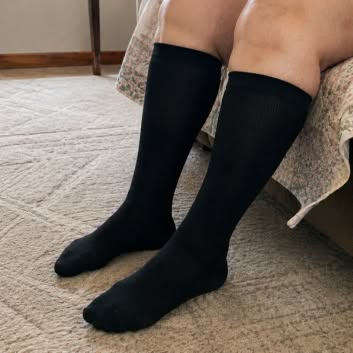
- Appearance: plain matte black knee-highs. They look like normal dress socks with trousers and unremarkable with jeans.
- Packing: a pair weighs almost nothing and rolls smaller than a t-shirt. Keep a spare in your carry-on for delayed connections.
- Washing on the road: hand wash in cold water in a hotel sink and hang dry overnight. Never a hotel tumble dryer — heat kills the gradient.
Flight socks vs the alternatives
| Option | What it does | Limitation |
|---|---|---|
| Airport 8–15 mmHg travel socks | Mild support, bought in a hurry | Too light to change much on a 10-hour sector |
| Calf sleeves | Compresses the calf only | Leaves the foot and ankle — where swelling shows — uncovered |
| Aisle walking alone | Restarts the calf pump, genuinely useful | You cannot walk for ten hours; seatbelt signs and night flights limit it |
| Footrest / leg hammock | Improves knee angle and comfort | Does nothing for venous return by itself |
| TrueFit 20–30 mmHg | Graduated ankle-to-calf pressure for the entire journey | Needs to go on before you leave, and washing after each wear |
How many pairs for a trip
One clean pair per travel day. For a return trip with a couple of long transit days, four pairs is the sweet spot; frequent flyers and couples travelling together take six. All bundles ship free worldwide and prices are in USD.
2 pairs
Try them out — still covered by the 30-day guarantee
$24.50/pair
$49.00 total $104.96
You save $55.96 (53% off)
Choose 2 pairs4 pairs
Enough to rotate through the work week
$22.49/pair
$89.96 total $209.92
You save $119.96 (57% off)
Choose 4 pairs6 pairs
Most chosen — a fresh pair for every day of the week
$19.98/pair
$119.88 total $314.88
You save $195.00 (62% off)
Choose 6 pairsAll prices in USD. A single pair at full price is $52.48 — every bundle includes free worldwide shipping and the 30-day money-back guarantee.
Not sure between S/M and L/XL? Measure your calf at its widest point and check the size guide — sizing is what determines whether you get the pressure you paid for.




%20--%3e%3csvg%20version='1.1'%20baseProfile='tiny'%20id='Layer_1'%20xmlns='http://www.w3.org/2000/svg'%20xmlns:xlink='http://www.w3.org/1999/xlink'%20x='0px'%20y='0px'%20viewBox='0%200%20512%20210.2'%20xml:space='preserve'%3e%3cpath%20id='XMLID_34_'%20d='M93.6,27.1C87.6,34.2,78,39.8,68.4,39c-1.2-9.6,3.5-19.8,9-26.1c6-7.3,16.5-12.5,25-12.9%20C103.4,10,99.5,19.8,93.6,27.1%20M102.3,40.9c-13.9-0.8-25.8,7.9-32.4,7.9c-6.7,0-16.8-7.5-27.8-7.3c-14.3,0.2-27.6,8.3-34.9,21.2%20c-15,25.8-3.9,64,10.6,85c7.1,10.4,15.6,21.8,26.8,21.4c10.6-0.4,14.8-6.9,27.6-6.9c12.9,0,16.6,6.9,27.8,6.7%20c11.6-0.2,18.9-10.4,26-20.8c8.1-11.8,11.4-23.3,11.6-23.9c-0.2-0.2-22.4-8.7-22.6-34.3c-0.2-21.4,17.5-31.6,18.3-32.2%20C123.3,42.9,107.7,41.3,102.3,40.9%20M182.6,11.9v155.9h24.2v-53.3h33.5c30.6,0,52.1-21,52.1-51.4c0-30.4-21.1-51.2-51.3-51.2H182.6z%20M206.8,32.3h27.9c21,0,33,11.2,33,30.9c0,19.7-12,31-33.1,31h-27.8V32.3z%20M336.6,169c15.2,0,29.3-7.7,35.7-19.9h0.5v18.7h22.4V90.2%20c0-22.5-18-37-45.7-37c-25.7,0-44.7,14.7-45.4,34.9h21.8c1.8-9.6,10.7-15.9,22.9-15.9c14.8,0,23.1,6.9,23.1,19.6v8.6l-30.2,1.8%20c-28.1,1.7-43.3,13.2-43.3,33.2C298.4,155.6,314.1,169,336.6,169z%20M343.1,150.5c-12.9,0-21.1-6.2-21.1-15.7c0-9.8,7.9-15.5,23-16.4%20l26.9-1.7v8.8C371.9,140.1,359.5,150.5,343.1,150.5z%20M425.1,210.2c23.6,0,34.7-9,44.4-36.3L512,54.7h-24.6l-28.5,92.1h-0.5%20l-28.5-92.1h-25.3l41,113.5l-2.2,6.9c-3.7,11.7-9.7,16.2-20.4,16.2c-1.9,0-5.6-0.2-7.1-0.4v18.7C417.3,210,423.3,210.2,425.1,210.2z%20'/%3e%3cg%3e%3c/g%3e%3cg%3e%3c/g%3e%3cg%3e%3c/g%3e%3cg%3e%3c/g%3e%3cg%3e%3c/g%3e%3cg%3e%3c/g%3e%3c/svg%3e)