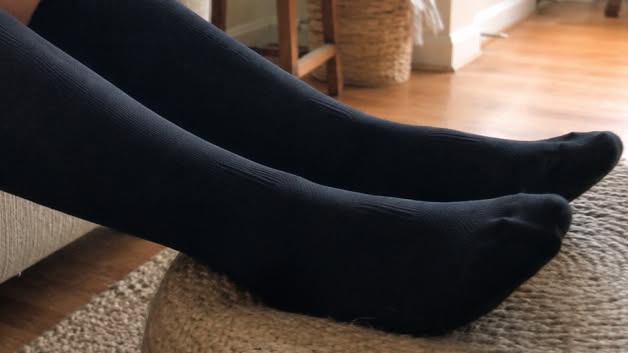
The default: all waking hours
Swelling and venous pooling are gravity problems. They build from the moment you stand up and get worse through the day. So compression is most useful during exactly the hours you're upright — typically 12 to 16 hours.
Putting them on before you get out of bed, or at least first thing in the morning, is the single biggest thing you can do to improve results. Your legs are at their least swollen then, so the socks hold that baseline instead of fighting fluid that's already accumulated.
By situation
| Situation | Wear time |
|---|---|
| Daily swelling / aching legs | All waking hours, every day |
| 12-hour shift | Whole shift plus the commute home |
| Flying | On before you leave home, off after you arrive — including layovers |
| Running recovery | 2–4 hours after the session |
| Pregnancy (with clinician approval) | Morning until bed, daily |
| Post-surgery | Exactly as your surgical team instructs — this may include overnight |
Why not overnight
Lying flat removes the gravitational load the socks are there to counteract, so there's little to gain. Meanwhile a rucked sock or a folded band can create a pressure point you won't feel while asleep. Unless your clinician has specifically prescribed overnight compression, take them off.
Building up if they feel strong at first
If 20–30 mmHg feels intense on day one, wear them 3–4 hours, then 6–8, then full days over about a week. Most people adapt quickly. What you should never do is push through numbness, tingling, colour change or pain — that indicates the wrong size, not adaptation. Check the size guide.
Looking after them
Wash after every day of wear, cold, and hang dry. Heat destroys elastane. With two or more pairs in rotation, each holds its compression roughly six months.




%20--%3e%3csvg%20version='1.1'%20baseProfile='tiny'%20id='Layer_1'%20xmlns='http://www.w3.org/2000/svg'%20xmlns:xlink='http://www.w3.org/1999/xlink'%20x='0px'%20y='0px'%20viewBox='0%200%20512%20210.2'%20xml:space='preserve'%3e%3cpath%20id='XMLID_34_'%20d='M93.6,27.1C87.6,34.2,78,39.8,68.4,39c-1.2-9.6,3.5-19.8,9-26.1c6-7.3,16.5-12.5,25-12.9%20C103.4,10,99.5,19.8,93.6,27.1%20M102.3,40.9c-13.9-0.8-25.8,7.9-32.4,7.9c-6.7,0-16.8-7.5-27.8-7.3c-14.3,0.2-27.6,8.3-34.9,21.2%20c-15,25.8-3.9,64,10.6,85c7.1,10.4,15.6,21.8,26.8,21.4c10.6-0.4,14.8-6.9,27.6-6.9c12.9,0,16.6,6.9,27.8,6.7%20c11.6-0.2,18.9-10.4,26-20.8c8.1-11.8,11.4-23.3,11.6-23.9c-0.2-0.2-22.4-8.7-22.6-34.3c-0.2-21.4,17.5-31.6,18.3-32.2%20C123.3,42.9,107.7,41.3,102.3,40.9%20M182.6,11.9v155.9h24.2v-53.3h33.5c30.6,0,52.1-21,52.1-51.4c0-30.4-21.1-51.2-51.3-51.2H182.6z%20M206.8,32.3h27.9c21,0,33,11.2,33,30.9c0,19.7-12,31-33.1,31h-27.8V32.3z%20M336.6,169c15.2,0,29.3-7.7,35.7-19.9h0.5v18.7h22.4V90.2%20c0-22.5-18-37-45.7-37c-25.7,0-44.7,14.7-45.4,34.9h21.8c1.8-9.6,10.7-15.9,22.9-15.9c14.8,0,23.1,6.9,23.1,19.6v8.6l-30.2,1.8%20c-28.1,1.7-43.3,13.2-43.3,33.2C298.4,155.6,314.1,169,336.6,169z%20M343.1,150.5c-12.9,0-21.1-6.2-21.1-15.7c0-9.8,7.9-15.5,23-16.4%20l26.9-1.7v8.8C371.9,140.1,359.5,150.5,343.1,150.5z%20M425.1,210.2c23.6,0,34.7-9,44.4-36.3L512,54.7h-24.6l-28.5,92.1h-0.5%20l-28.5-92.1h-25.3l41,113.5l-2.2,6.9c-3.7,11.7-9.7,16.2-20.4,16.2c-1.9,0-5.6-0.2-7.1-0.4v18.7C417.3,210,423.3,210.2,425.1,210.2z%20'/%3e%3cg%3e%3c/g%3e%3cg%3e%3c/g%3e%3cg%3e%3c/g%3e%3cg%3e%3c/g%3e%3cg%3e%3c/g%3e%3cg%3e%3c/g%3e%3c/svg%3e)
