During the run, or after it?
These are two different products in practice, even when it is the same sock. Worn during a run, compression reduces the high-frequency oscillation of the calf muscle on impact and adds a proprioceptive sense of support. Worn after, it works on venous return and fluid clearance in legs that have just taken thousands of loading cycles.
If you can only pick one, pick after. It is the use case with the most consistent reporting from runners and the most supportive research, and it does not risk changing anything about how you run.
What the evidence actually supports
| Claim | How well supported |
|---|---|
| Reduced post-run muscle soreness | Reasonably well supported — the main reason to own a pair |
| Faster perceived recovery between sessions | Widely reported by runners; consistent with the mechanism |
| Reduced muscle oscillation during running | Measurable, though what it means for outcomes is debated |
| Less leg swelling after long runs and races | Well supported — same mechanism as travel and standing use |
| Improved running economy or race time | Weak and inconsistent. Do not buy for this |
| Preventing cramp | Not supported. Cramp is mostly fatigue and conditioning |
| Curing shin splints | No. Helps the symptom; the cause is training load and mechanics |
Using them for recovery properly
- Decide during or after. For recovery, put them on within an hour of finishing. For running in, wear them from the warm-up so your legs are not adjusting mid-session.
- Shower and dry first for recovery wear. Clean, dry skin under compression is more comfortable and better for the knit.
- Wear for 2–4 hours after a hard session. That covers the window when most people report the biggest difference in next-day soreness.
- Combine with elevation for the first 20 minutes. Legs up against a wall while the compression is on gives the best of both.
- Use them on the travel day, not just race day. The flight or drive to a race is often more damaging to your legs than the race itself.
- Wash cold and hang dry after every wear. Sweat and heat are what age compression fabric fastest.
The most common mistake is putting them on at bedtime and sleeping in them. Lying flat already removes the gravitational load, so most of the benefit is gone — more on that here. Get them on within the hour after finishing instead.
Shin splints, calf strain and the honest caveat
Medial tibial stress syndrome — shin splints — is an overload injury. It comes from doing more, faster, or on harder surfaces than your tissues have adapted to, often on shoes past their useful life. Compression can make the leg feel better during and after a run, and some runners use it to stay comfortable while they fix the underlying issue. It is not a treatment.
The things that fix it: reduce load for a couple of weeks, build calf and foot strength, increase mileage by small increments, replace shoes on schedule, and vary surfaces. If pain is focal, worsening, or present at rest, get it assessed — stress fractures present the same way at first.
Race day and race travel
- Never debut socks on race day. Test over at least two long runs, including one in similar heat.
- The travel matters more than the race. A long-haul flight or a six-hour drive the day before a marathon leaves legs heavier than the race will. Wear compression for the journey — see compression socks for flying.
- Post-race is the highest-value hour. Change into a clean, dry pair once you have got through the finish area.
- Pack a spare. Wet socks after a rainy race are miserable and you will want the recovery pair dry.
Socks or calf sleeves?
Sleeves cover the calf but stop at the ankle, so you keep your favourite running sock. That is convenient for running in, and it is why you see so many sleeves at races. For recovery it is the wrong tool: fluid pools in the foot and around the ankle, and a sleeve leaves exactly that area uncompressed — some runners even get a puffy ankle ring below the sleeve. Full comparison in socks vs sleeves vs stockings.
Fit and sizing for runners
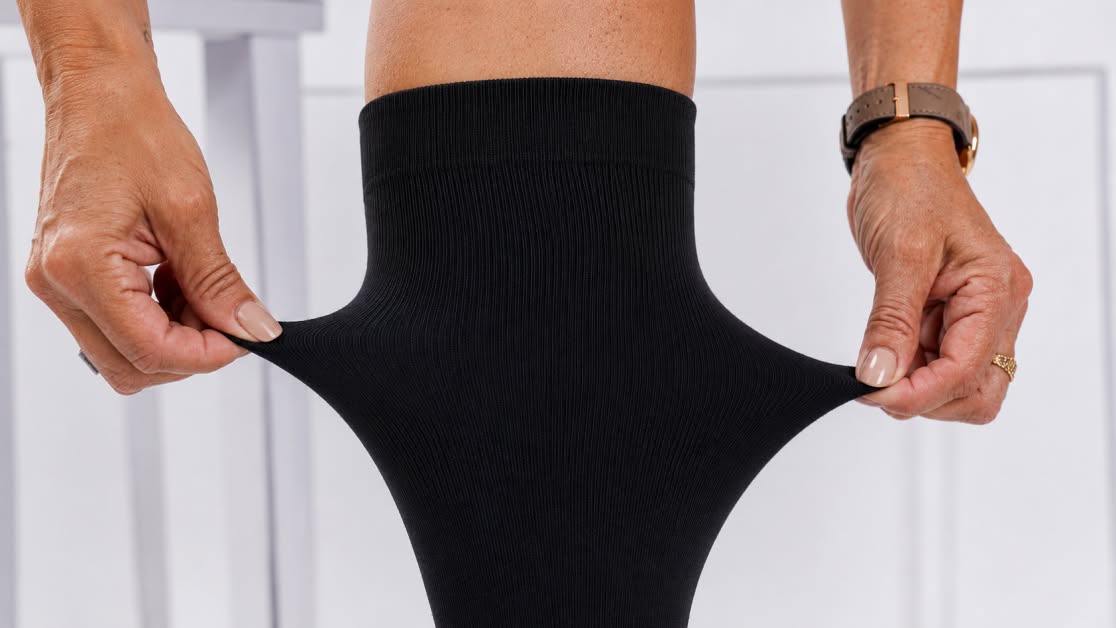
Runners tend to have larger calves relative to shoe size than the general population, which is exactly the case where shoe-size-only sizing charts fail. Measure the widest point of your calf: over 16 inches means L/XL regardless of your shoe size. The TrueFit wide comfort strap has a much larger stretch range than a conventional narrow band, which is why muscular calves get on with it.
Full conversions and measuring instructions are in the size guide, and size exchanges are free within 30 days.
How many pairs
One clean pair per hard session, plus travel wear. Four pairs covers a typical training week; six suits high-mileage runners and anyone using them for work as well as running.
2 pairs
Try them out — still covered by the 30-day guarantee
$24.50/pair
$49.00 total $104.96
You save $55.96 (53% off)
Choose 2 pairs4 pairs
Enough to rotate through the work week
$22.49/pair
$89.96 total $209.92
You save $119.96 (57% off)
Choose 4 pairs6 pairs
Most chosen — a fresh pair for every day of the week
$19.98/pair
$119.88 total $314.88
You save $195.00 (62% off)
Choose 6 pairsAll prices in USD. A single pair at full price is $52.48 — every bundle includes free worldwide shipping and the 30-day money-back guarantee.




%20--%3e%3csvg%20version='1.1'%20baseProfile='tiny'%20id='Layer_1'%20xmlns='http://www.w3.org/2000/svg'%20xmlns:xlink='http://www.w3.org/1999/xlink'%20x='0px'%20y='0px'%20viewBox='0%200%20512%20210.2'%20xml:space='preserve'%3e%3cpath%20id='XMLID_34_'%20d='M93.6,27.1C87.6,34.2,78,39.8,68.4,39c-1.2-9.6,3.5-19.8,9-26.1c6-7.3,16.5-12.5,25-12.9%20C103.4,10,99.5,19.8,93.6,27.1%20M102.3,40.9c-13.9-0.8-25.8,7.9-32.4,7.9c-6.7,0-16.8-7.5-27.8-7.3c-14.3,0.2-27.6,8.3-34.9,21.2%20c-15,25.8-3.9,64,10.6,85c7.1,10.4,15.6,21.8,26.8,21.4c10.6-0.4,14.8-6.9,27.6-6.9c12.9,0,16.6,6.9,27.8,6.7%20c11.6-0.2,18.9-10.4,26-20.8c8.1-11.8,11.4-23.3,11.6-23.9c-0.2-0.2-22.4-8.7-22.6-34.3c-0.2-21.4,17.5-31.6,18.3-32.2%20C123.3,42.9,107.7,41.3,102.3,40.9%20M182.6,11.9v155.9h24.2v-53.3h33.5c30.6,0,52.1-21,52.1-51.4c0-30.4-21.1-51.2-51.3-51.2H182.6z%20M206.8,32.3h27.9c21,0,33,11.2,33,30.9c0,19.7-12,31-33.1,31h-27.8V32.3z%20M336.6,169c15.2,0,29.3-7.7,35.7-19.9h0.5v18.7h22.4V90.2%20c0-22.5-18-37-45.7-37c-25.7,0-44.7,14.7-45.4,34.9h21.8c1.8-9.6,10.7-15.9,22.9-15.9c14.8,0,23.1,6.9,23.1,19.6v8.6l-30.2,1.8%20c-28.1,1.7-43.3,13.2-43.3,33.2C298.4,155.6,314.1,169,336.6,169z%20M343.1,150.5c-12.9,0-21.1-6.2-21.1-15.7c0-9.8,7.9-15.5,23-16.4%20l26.9-1.7v8.8C371.9,140.1,359.5,150.5,343.1,150.5z%20M425.1,210.2c23.6,0,34.7-9,44.4-36.3L512,54.7h-24.6l-28.5,92.1h-0.5%20l-28.5-92.1h-25.3l41,113.5l-2.2,6.9c-3.7,11.7-9.7,16.2-20.4,16.2c-1.9,0-5.6-0.2-7.1-0.4v18.7C417.3,210,423.3,210.2,425.1,210.2z%20'/%3e%3cg%3e%3c/g%3e%3cg%3e%3c/g%3e%3cg%3e%3c/g%3e%3cg%3e%3c/g%3e%3cg%3e%3c/g%3e%3cg%3e%3c/g%3e%3c/svg%3e)