The short verdict
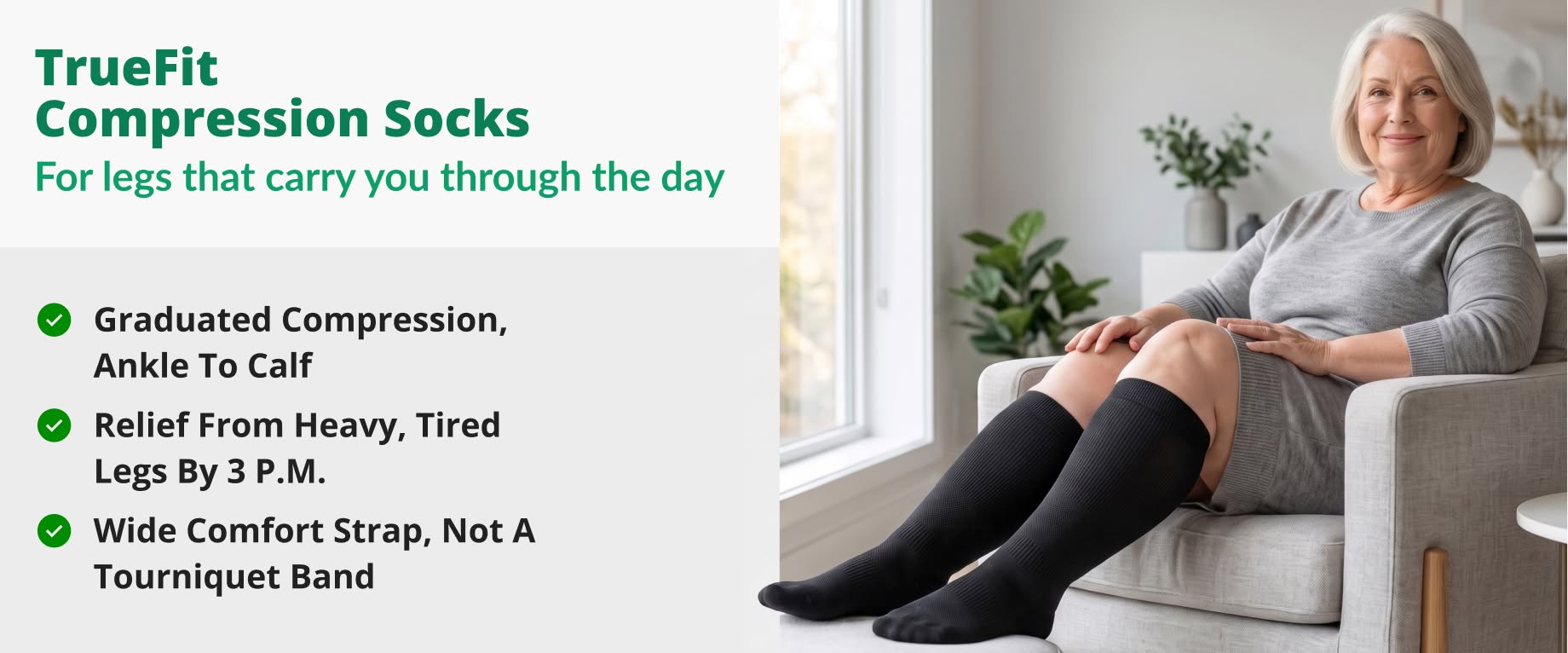
TrueFit is a true graduated 20–30 mmHg compression sock whose one genuine design innovation is the wide comfort strap at the top of the calf, replacing the narrow elastic band that makes most compression socks unbearable after eight hours. If the band is the reason your last pair ended up in a drawer, this is the fix. If you need prescription 30–40 mmHg, this isn't that product.
Everything else — the bamboo-derived knit, the reinforced heel and toe, the moisture handling — is competent rather than revolutionary. The strap is the reason to buy, and it is a better reason than most compression brands can offer, because the single biggest failure of compression therapy is not the garment's pressure profile. It is people stopping wearing it.
How we assessed them
This review is written by the team that sells the product, so treat it as a specification walkthrough plus an honest account of what customers report, not an independent lab test. Three things inform it:
- The product specification — compression rating, gradient, fibre composition, construction and sizing tolerances.
- Extended wear across the use cases we sell into — twelve-hour hospital shifts, long-haul flights, retail and trade shifts, and post-run recovery.
- 12,417 customer reviews, including the negative ones. Where a complaint recurs, we say so below rather than hiding it. Read the unfiltered review wall.
What you're actually getting
| Specification | Detail |
|---|---|
| Compression | 20–30 mmHg graduated, firmest at the ankle |
| Top band | Wide comfort strap, non-binding, roll-resistant |
| Length | Knee-high, finishing just below the knee crease |
| Material | Bamboo-derived viscose blended with nylon and spandex |
| Construction | Reinforced heel and toe, flat toe seam, ribbed calf |
| Sizes | S/M and L/XL, unisex, calves to 16 in and 20 in |
| Colour | Matte black, no medical branding |
| Price | From $49 for two pairs (USD) |
| Shipping | Free worldwide, tracked |
| Guarantee | 30 days, money back, worn pairs accepted |
The comfort strap: why it matters
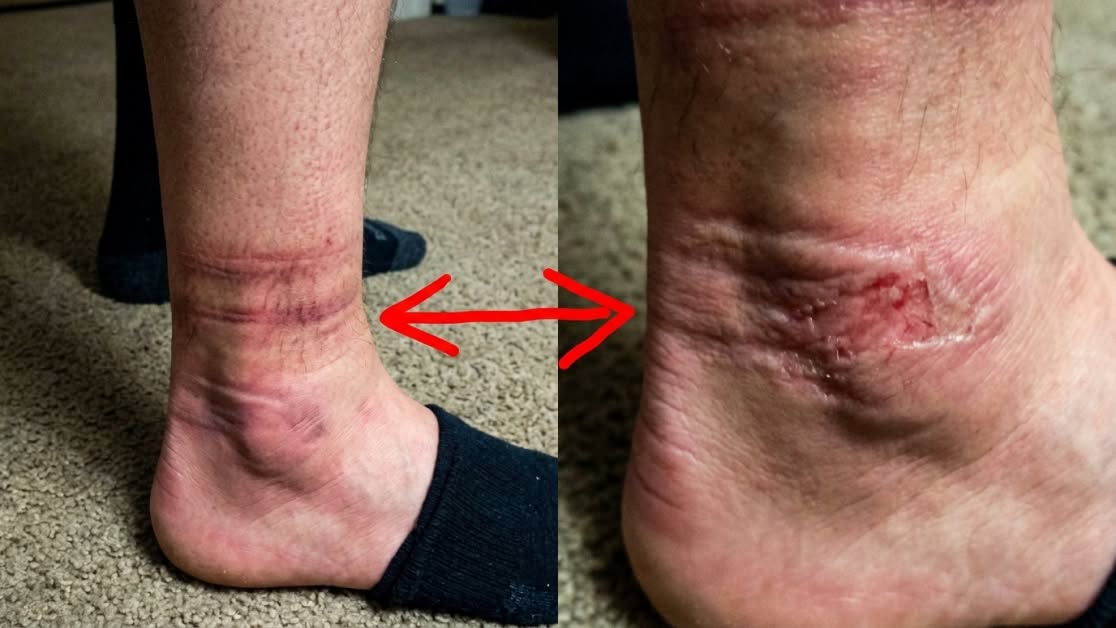
Almost every compression sock finishes with a narrow elastic cuff. That cuff has to hold the sock up against the downward pull of the whole garment, so the holding force concentrates into a two-centimetre strip and leaves the groove you know. TrueFit spreads the same force across a much wider panel: the same job, a fraction of the local pressure, and a far bigger stretch range for muscular or larger calves.
This matters more than it sounds, because compliance is everything with compression. A clinically perfect sock you stop wearing on day four delivers nothing at all. The strap is what makes hour twelve tolerable — read how compression socks work for the underlying mechanism.
It is not magic. A wide strap on the wrong size still marks the leg, because the problem then is total circumference, not band width. If you get a deep ring that hasn't faded 20 minutes after taking the socks off, you are in the wrong size and should exchange it.
Compression, in practice
20–30 mmHg is the firm end of over-the-counter compression. Expect it to feel obvious at the ankle when you first pull the sock on, supportive rather than tight through the calf, and largely unnoticeable within the first hour. Customers moving up from a 15–20 mmHg drugstore sock consistently describe the first day as "a lot firmer than expected" and the third day as normal.
The gradient is the important part and it is the part cheap socks get wrong. Pressure must be highest at the ankle and fall as it climbs, so the squeeze works with the calf pump to push venous blood upward. A sock that is uniformly tight, or tightest at the top, does the opposite of what you want. Our mmHg guide lays out the levels side by side.
Fabric, breathability and durability
The bamboo-viscose blend breathes and wicks noticeably better than the all-nylon compression socks sold in pharmacies, which is what makes them survivable inside closed shoes across a long shift. Odour resistance is genuinely good: the recurring nurse feedback is that the socks come off at hour thirteen smelling like ordinary socks at hour six.
Heel and toe are reinforced, which is where thin compression socks fail first, and the toe seam is flat enough not to irritate. Durability is normal for the category: three to six months of daily wear if washed cold and hang dried, drastically less if tumble dried even once or twice. Heat is what destroys the elastane, and elastane is the whole product. Washing instructions here.
Sizing accuracy
Sizing is honest but calf-driven, not shoe-driven, and this is the single biggest source of bad first experiences. S/M covers women's US 5–9.5 and men's 4–8.5 with calves to 16 inches; L/XL covers women's 10–13 and men's 9–13 with calves to 20 inches. If the two measurements disagree, follow the calf.
Two sizes is genuinely a limitation. Very slim calves and calves beyond 20 inches are less well served than they would be by a brand offering four or five widths. We would rather say that than pretend otherwise — the free exchange policy exists precisely because two sizes cannot fit every leg perfectly. Measure first using the size guide.
Day one to day thirty
- Day 1 — firmer than expected if you are coming from light compression. Put them on in the morning, before your legs swell; it makes the first fitting far easier.
- Days 2–3 — the pressure stops registering as pressure. Most people notice the difference in reverse: on the day they forget to wear them.
- Week 1 — the reported change is end-of-day heaviness and ankle swelling, not a dramatic transformation. Anyone promising more than that is selling you something.
- Week 4 — the practical question becomes laundry. Compression needs washing after each wear, which is why customers who bought two pairs usually come back for six.
Pros and cons
Pros
- Genuine 20–30 mmHg gradient, not vague "compression"
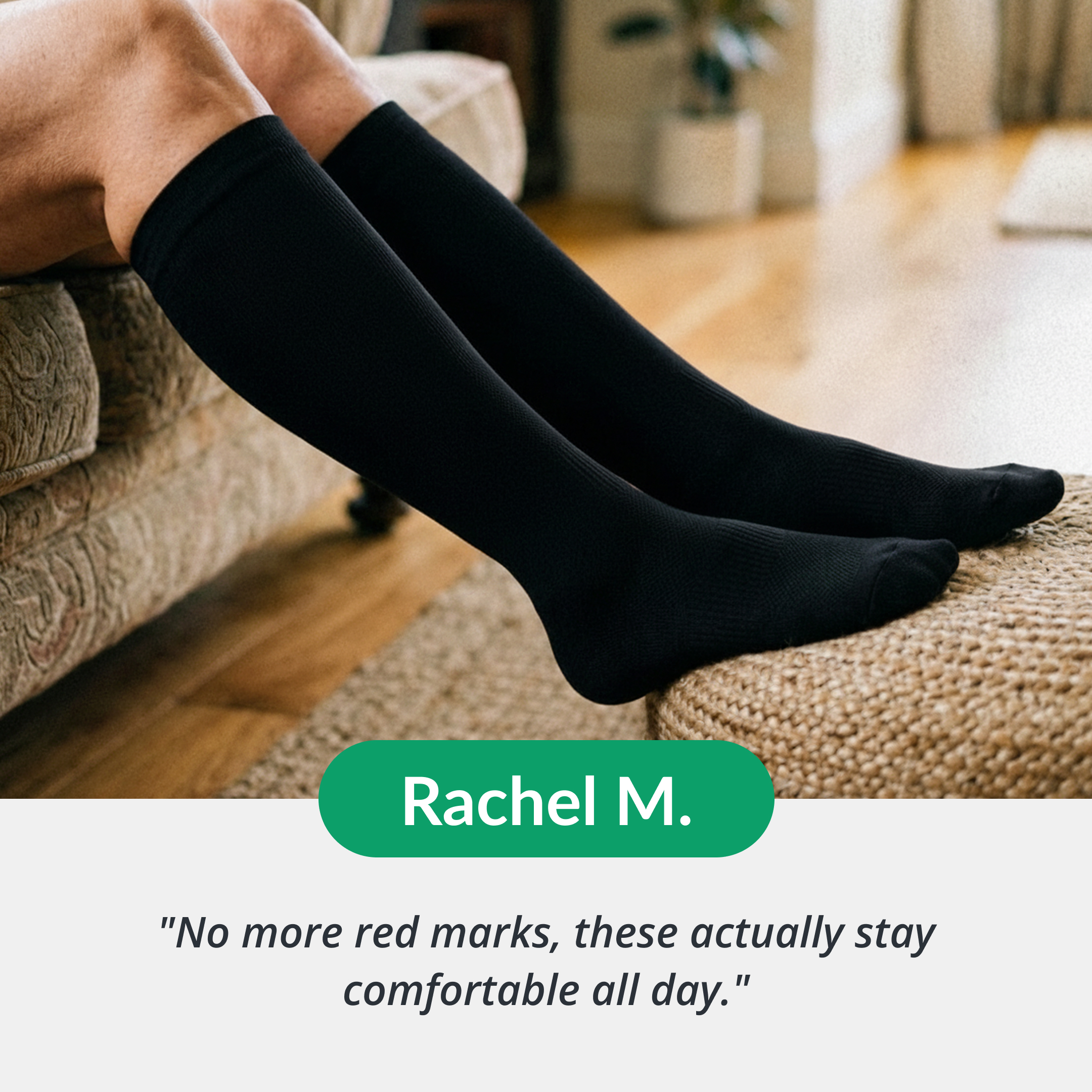
- The comfort strap solves the real-world reason people quit
- Breathable enough for 12-hour shifts in closed shoes
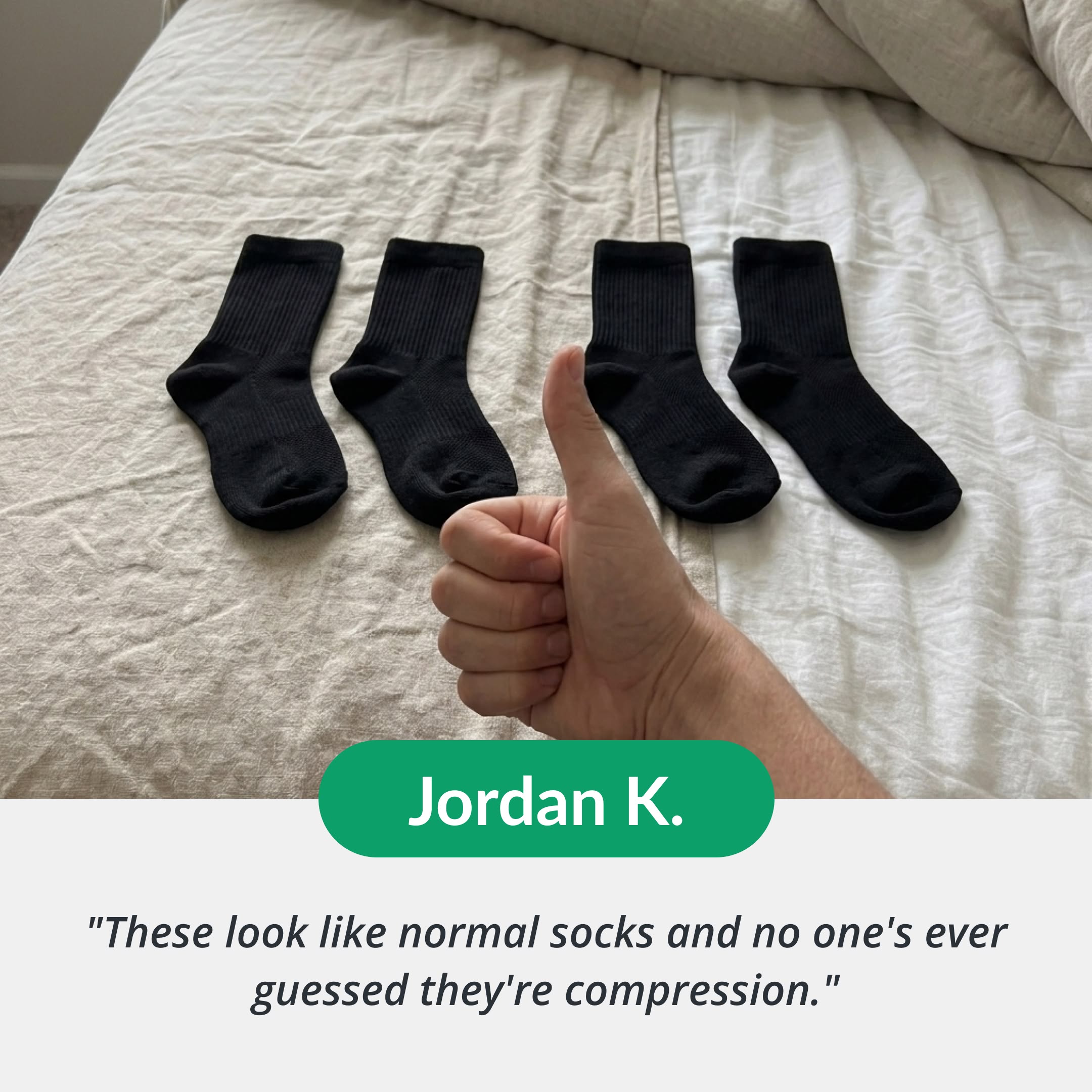
- Looks like an ordinary black sock — no medical styling
- Free worldwide shipping, prices in USD, no currency surprises
- 30-day guarantee that covers worn pairs, plus free size exchanges
Cons
- Only two sizes — very large or very slim calves are less well served
- 20–30 mmHg feels firm if you're coming from 15–20 mmHg
- Bundles are where the value is; a single pair isn't the sensible buy
- One colour only
- Not a medical device, so not a substitute for prescribed therapy
Versus the alternatives
| Option | Typical pressure | Where it wins | Where it loses |
|---|---|---|---|
| TrueFit | 20–30 mmHg | All-day comfort at the band; bundle pricing | Two sizes, one colour |
| Pharmacy support socks | 8–15 / 15–20 mmHg | Cheap, available today | Often fades out before a long shift does |
| Prescription stockings | 30–40 mmHg | Clinically fitted for diagnosed disease | Assessment required, costly, hard to put on |
| Calf sleeves | Varies | Fine for calf muscle support in sport | No foot, so no help for ankle swelling |
The detailed comparison is in socks vs sleeves vs stockings.
Price and value
2 pairs
Try them out — still covered by the 30-day guarantee
$24.50/pair
$49.00 total $104.96
You save $55.96 (53% off)
Choose 2 pairs4 pairs
Enough to rotate through the work week
$22.49/pair
$89.96 total $209.92
You save $119.96 (57% off)
Choose 4 pairs6 pairs
Most chosen — a fresh pair for every day of the week
$19.98/pair
$119.88 total $314.88
You save $195.00 (62% off)
Choose 6 pairsAll prices in USD. A single pair at full price is $52.48 — every bundle includes free worldwide shipping and the 30-day money-back guarantee.
At $119.88 for six pairs, the per-pair cost lands well under a single pharmacy pair, and six pairs is roughly a full working week between washes — which is the realistic requirement for anyone wearing them daily. Two pairs is the "try them" option rather than the value option; if you already know you want compression for work, the six-pack is the one that ends up in the drawer instead of a half-used two-pack.
Who should skip them
Anyone prescribed 30–40 mmHg, and anyone with peripheral arterial disease, significant neuropathy or uncontrolled heart failure without clearance from a clinician. If you have diabetes, read the diabetes-specific page first. If your swelling is new, painful, or in one leg only, see a doctor before buying anything — why that matters.
Final rating
4.8/5 from 12,417 customers, and our own verdict matches: the best compression sock for people who have already tried compression and given up on it. Not the widest size range on the market, not the cheapest single pair, but the one most likely to still be in use in month three.




%20--%3e%3csvg%20version='1.1'%20baseProfile='tiny'%20id='Layer_1'%20xmlns='http://www.w3.org/2000/svg'%20xmlns:xlink='http://www.w3.org/1999/xlink'%20x='0px'%20y='0px'%20viewBox='0%200%20512%20210.2'%20xml:space='preserve'%3e%3cpath%20id='XMLID_34_'%20d='M93.6,27.1C87.6,34.2,78,39.8,68.4,39c-1.2-9.6,3.5-19.8,9-26.1c6-7.3,16.5-12.5,25-12.9%20C103.4,10,99.5,19.8,93.6,27.1%20M102.3,40.9c-13.9-0.8-25.8,7.9-32.4,7.9c-6.7,0-16.8-7.5-27.8-7.3c-14.3,0.2-27.6,8.3-34.9,21.2%20c-15,25.8-3.9,64,10.6,85c7.1,10.4,15.6,21.8,26.8,21.4c10.6-0.4,14.8-6.9,27.6-6.9c12.9,0,16.6,6.9,27.8,6.7%20c11.6-0.2,18.9-10.4,26-20.8c8.1-11.8,11.4-23.3,11.6-23.9c-0.2-0.2-22.4-8.7-22.6-34.3c-0.2-21.4,17.5-31.6,18.3-32.2%20C123.3,42.9,107.7,41.3,102.3,40.9%20M182.6,11.9v155.9h24.2v-53.3h33.5c30.6,0,52.1-21,52.1-51.4c0-30.4-21.1-51.2-51.3-51.2H182.6z%20M206.8,32.3h27.9c21,0,33,11.2,33,30.9c0,19.7-12,31-33.1,31h-27.8V32.3z%20M336.6,169c15.2,0,29.3-7.7,35.7-19.9h0.5v18.7h22.4V90.2%20c0-22.5-18-37-45.7-37c-25.7,0-44.7,14.7-45.4,34.9h21.8c1.8-9.6,10.7-15.9,22.9-15.9c14.8,0,23.1,6.9,23.1,19.6v8.6l-30.2,1.8%20c-28.1,1.7-43.3,13.2-43.3,33.2C298.4,155.6,314.1,169,336.6,169z%20M343.1,150.5c-12.9,0-21.1-6.2-21.1-15.7c0-9.8,7.9-15.5,23-16.4%20l26.9-1.7v8.8C371.9,140.1,359.5,150.5,343.1,150.5z%20M425.1,210.2c23.6,0,34.7-9,44.4-36.3L512,54.7h-24.6l-28.5,92.1h-0.5%20l-28.5-92.1h-25.3l41,113.5l-2.2,6.9c-3.7,11.7-9.7,16.2-20.4,16.2c-1.9,0-5.6-0.2-7.1-0.4v18.7C417.3,210,423.3,210.2,425.1,210.2z%20'/%3e%3cg%3e%3c/g%3e%3cg%3e%3c/g%3e%3cg%3e%3c/g%3e%3cg%3e%3c/g%3e%3cg%3e%3c/g%3e%3cg%3e%3c/g%3e%3c/svg%3e)